In the complex world of industrial operations, precision, safety, and efficiency are paramount. Achieving these critical objectives relies heavily on the accurate monitoring and control of fundamental physical parameters such as pressure, fluid levels, and flow rates. Without robust and reliable sensing and actuation components, even the most sophisticated systems can falter, leading to downtime, safety hazards, and significant financial losses. This article explores the indispensable role of pressure switches, water level sensors, flow sensors, and safety relief valves in ensuring the seamless and secure operation of diverse industrial processes.
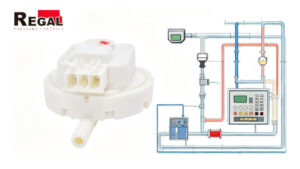
Pressure switches are the unsung heroes in countless industrial applications, acting as critical guardians that respond to changes in system pressure. These electro-mechanical or electronic devices provide an on/off signal when a predetermined pressure set-point is reached, triggering an action such as starting or stopping a pump, activating an alarm, or shutting down a system. Their reliability is crucial for both operational efficiency and safety.
- Interruptores de pressão de ar: Widely utilized in HVAC systems, pneumatic control, combustion air proving, and vacuum systems, air pressure switches ensure that airflows and pressures remain within safe and operational limits. For instance, in a furnace, an air pressure switch might confirm adequate airflow before allowing the burner to ignite, preventing dangerous gas buildup. In pneumatic systems, they can monitor compressed air supply, signaling low pressure conditions that could impact tool performance or process integrity.
- Interruptores de pressão de água: Essential for water management, these switches are found in pumping stations, irrigation systems, water treatment plants, and industrial cooling circuits. They protect pumps from dry running, maintain system pressure within desired ranges, and activate booster pumps when demand increases. Their ability to withstand corrosive environments and provide consistent performance is vital for uninterrupted water supply and process control.
The selection of the right pressure switch involves considering factors such as media compatibility, pressure range, set-point accuracy, hysteresis, and environmental conditions. High-quality switches offer superior repeatability and longevity, minimizing maintenance and maximizing uptime.
Monitoring the Unseen: Water Level Switches and Sensors
Fluid level management is a cornerstone of many industrial processes, from chemical manufacturing to wastewater treatment. Accurately monitoring and controlling liquid levels prevents overflows, dry running of pumps, and ensures optimal inventory management. Both water level switches and continuous level sensors play distinct yet complementary roles.
- Interruptores de nível de água: These devices provide discrete (on/off) signals based on whether a liquid has reached a specific high or low level. Common types include float switches, conductivity probes, and optical sensors. They are ideal for pump control (e.g., emptying a tank when full or filling when empty), high/low alarm activation, and preventing spills or equipment damage. Their simplicity and robustness make them a popular choice for many basic level control applications.
- Sensores de nível de água: For applications requiring continuous monitoring of liquid levels, water level sensors (also known as level transmitters) are employed. Technologies like ultrasonic, hydrostatic, radar, and guided wave radar provide analog or digital outputs proportional to the liquid level. This continuous data allows for more sophisticated process control, precise dosing, inventory tracking, and trend analysis, enabling operators to optimize processes and react proactively to changes.
Whether for simple point-level detection or complex continuous measurement, reliable level control components are fundamental to preventing costly errors and ensuring process stability.
The Dynamics of Movement: Flow Sensors
Understanding and controlling the flow of liquids and gases is critical across virtually every industrial sector. Flow sensors, or flow meters, measure the rate at which a fluid moves through a pipe or conduit, providing essential data for process efficiency, product quality, and safety.
From monitoring cooling water in power plants to ensuring precise chemical dosing in manufacturing, flow sensors provide real-time insights. They can detect blockages, leaks, and ensure that fluids are delivered at the correct rate for optimal process performance. Common sensing principles include paddle wheel, electromagnetic, ultrasonic, and thermal mass. Each type offers specific advantages depending on the fluid properties, pipe size, and required accuracy. Implementing the correct flow sensor can lead to significant savings in material usage, energy consumption, and product consistency.
A Última Linha de Defesa: Válvulas de Alívio de Segurança
While sensors and switches ensure operational control, safety relief valves stand as the ultimate safeguard against catastrophic equipment failure due to overpressure. These mechanical devices are designed to automatically open and discharge excess fluid (liquid or gas) when the system pressure exceeds a predetermined set-point, thereby protecting pressure vessels, piping systems, and other equipment from rupture or explosion.
Safety relief valves are non-negotiable components in systems handling pressurized fluids, including boilers, compressors, chemical reactors, and storage tanks. Their design and selection are governed by stringent international safety standards and codes to ensure they function reliably when called upon. Regular inspection, testing, and maintenance of these critical “parts” are paramount to maintaining plant safety and regulatory compliance, preventing injuries, environmental damage, and extensive property loss.
The Importance of Quality Parts and Integrated Solutions
The effectiveness of any industrial control system is only as good as its weakest link. This underscores the critical importance of specifying and procuring high-quality “parts” for all components discussed: pressure switches, water level switches, water level sensors, flow sensors, and safety relief valves. Inferior components can lead to premature failure, inaccurate readings, and compromised safety, ultimately costing more in the long run through increased maintenance, downtime, and potential hazards.
Beyond individual component quality, the seamless integration of these technologies into a cohesive control system is vital. Modern industrial automation demands components that can communicate effectively with PLCs, DCSs, and SCADA systems, providing the data necessary for advanced analytics, predictive maintenance, and remote monitoring. Partnering with reputable suppliers who offer comprehensive technical support, product longevity, and adherence to industry standards ensures that your industrial control systems are robust, reliable, and future-proof.
Conclusão
Pressure, level, and flow control technologies, alongside essential safety relief valves, form the bedrock of safe, efficient, and compliant industrial operations. From the precise on/off action of a pressure switch to the continuous data stream from a level sensor, and the critical protection offered by a safety relief valve, each component plays a vital role. Investing in high-quality parts and intelligently integrating these solutions empowers businesses to optimize processes, safeguard personnel and assets, reduce operational costs, and maintain a competitive edge in today’s demanding industrial landscape. Understanding their function and selecting the right components are key steps towards achieving operational excellence.